Umamifinance hedging - Delta Exposure, Costs, and Buffer Limits
Umamifinance hedging uses internal netting in GM Vaults to reduce exposure to non-deposit assets. The Arbitrum vaults target the deposited asset's exposure and use external trades when internal matching falls short. Asset buffers reduce constant rebalancing, while changing allocations affect costs and available withdrawal liquidity.
ETH Exposure and USDC Delta Neutrality
An ETH-denominated GM Vault aims to retain ETH price exposure, while its USDC counterpart targets delta neutrality. Delta describes a position's sensitivity to price movements. Choosing ETH exposure therefore leaves ETH's market movement relevant to the position's dollar value. Within the ETH-backed GMI, or GM Index, liquidity spans ETH-USDC, XRP-USDC, DOGE-USDC, and LTC-USDC. Those markets explain why a single deposit asset can require hedging against other assets. The exposure target and the markets earning liquidity-provider revenue describe different parts of the strategy.
Internal Netting and the Trading Router
Internal netting facilitates trades between GM Vaults to offset unwanted asset exposures. The ETH and USDC vaults within the same index can match adjustments internally. This reduces external trading that would otherwise be needed to align holdings with different exposure targets. The saving comes from matching adjustments across the system; it isn't a fixed discount on each deposit.
The Trading Router handles external trades when internal matching isn't sufficient.
What Determines the Cost of GM Vault Hedging?
Hedging costs depend on the adjustments that the strategy needs, including residual external positions after internal netting. Changing index weights affect the work required to keep exposure aligned. There's no single fixed charge that captures every hedge, deposit, and exit.
The GM Vault fee model uses a 2% annual charge on assets under management and a 20% charge on generated yield. The yield fee doesn't apply to the entire deposit balance.
Deposit and withdrawal charges depend on execution-time weights of the transacted asset and GM tokens within the index. The fee model adds 0.1% of the amount deposited or withdrawn to fund external position management. That component isn't an annual hedging rate.
Deposit and withdrawal execution also carries an ETH-denominated charge for keeper gas and price-feed use. Comparing costs requires valuing that ETH alongside the assets entering or leaving the vault.
Trading-fee revenue needs to cover strategy operations and applicable vault charges before it becomes retained yield. Reducing external execution improves one cost input without fixing the final return.
Rebalance Keepers and Configurable Tolerances
The Rebalance Keeper submits strategy weights and hedge configuration generated by an off-chain financial model. On-chain checks validate those inputs against the vault's rules. The model considers allocations to GM markets alongside external hedges, connecting portfolio construction with exposure adjustment.
Administrative configuration can change strategy tolerances, swap tolerances, fees, and GMI weights. A quoted target therefore belongs to a particular configuration. Keeper validation constrains an update; it doesn't make every strategy parameter immutable. Emergency pause powers can also interrupt vault functionality.
Asset Buffers Between Scheduled Rebalances
GM Vaults reserve a small portion of deposited assets outside GM tokens as an asset buffer. This reserve helps avoid constant rebalancing. Rebalancing itself carries operational costs, so the buffer gives the strategy room to manage exposure between adjustments.
The GM Vault design uses multi-hour rebalancing intervals. Prices and market weights can move between those adjustments, so exposure management is periodic. Exhausting the buffer doesn't automatically trigger a rebalance in this buffer-based implementation. A buffer reduces the need for constant action; it doesn't promise zero delta in every block. The relevant tolerance belongs to the configuration governing the particular vault.
Does Delta Hedging Eliminate Trader Profit and Loss?
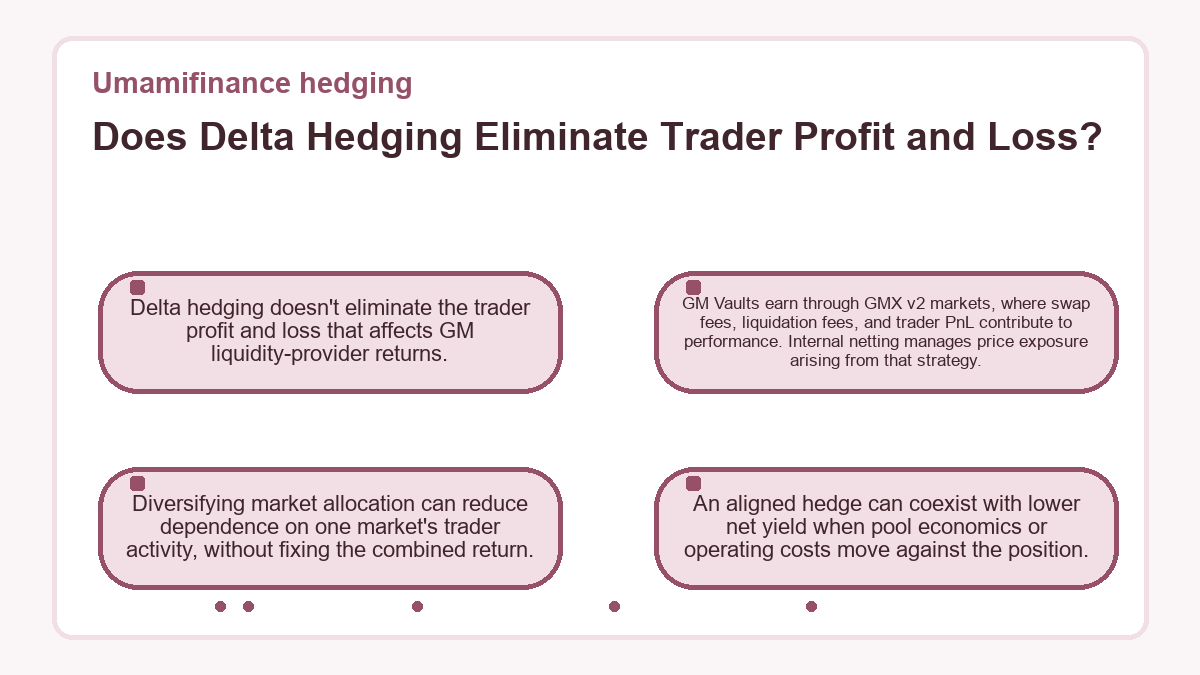
Delta hedging doesn't eliminate the trader profit and loss that affects GM liquidity-provider returns. GM Vaults earn through GMX v2 markets, where swap fees, liquidation fees, and trader PnL contribute to performance. Internal netting manages price exposure arising from that strategy. Diversifying market allocation can reduce dependence on one market's trader activity, without fixing the combined return. An aligned hedge can coexist with lower net yield when pool economics or operating costs move against the position.
Buffer Coverage Before an Exit
A GM Vault holder who needs to unwind a position can compare withdrawal amounts using one condition: whether the available buffer covers the requested underlying assets.
- Identify the receipt token, underlying asset, and backing configuration before using a buffer figure.
- Include the execution-time withdrawal charge and separate ETH execution cost when comparing the assets that an exit can return.
- For an amount within available buffer liquidity, a refill isn't required solely to cover that amount; other withdrawal limits can still apply.
- For an amount above available buffer liquidity, wait for a rebalance to replenish reserves before attempting that full withdrawal through the buffer-based route.
- Once the vault permits the withdrawal, submit it; confirm the share reduction and underlying-asset transfer in the completed transaction.
Linked GM Markets and Withdrawal Liquidity
In the linked-index withdrawal design, a circuit breaker in one underlying GMX market can block the whole vault's rebalance, so waiting for the ordinary interval doesn't guarantee that liquidity will refill on schedule.
Exposure alignment, share value, and spendable assets remain separate properties of a position. Profit can increase a receipt's price per share in underlying-asset units while withdrawal availability still depends on reserves and applicable limits. The receipt identifies the particular vault, including distinct strategies represented by ETH-backed gmUSDC and BTC-backed gmUSDC.
Questions people ask about Umamifinance hedging
Does the $80,000 Internal-Netting Figure Represent an Annual Cost?
The roughly $80,000 internal-netting cost figure doesn't establish an annual fee. That reported result accompanies $10 million in total value locked without a specified measurement period. Dividing cost by capital alone can't establish an annual rate or an individual deposit charge. An annual comparison needs the measurement period, capital base, and expenses included in the figure.
Is the 0.15% Delta Variance a Maximum Loss Limit?
The roughly 0.15% delta-variance figure belongs to the GM Vault rebalancing description and doesn't define a maximum loss. It accompanies a strategy that rebalances at multi-hour intervals. A delta parameter concerns exposure alignment; it doesn't cap trader PnL, execution charges, or the deposited asset's price movement. Strategy tolerances can also change through administrative configuration.
Do GM Vault Depositors Need Separate Collateral for Internal Netting?
The internal-netting arrangement between ETH and USDC vaults in the same index doesn't require a separate collateral leg. It doesn't establish that external hedges have identical requirements. External trades remain part of the strategy when internal matching can't supply the necessary adjustment.
Can ETH-Backed Hedge Assumptions Apply Unchanged to gmWBTC?
The documented gmWBTC strategy draws on the BTC GM market, so the ETH-backed index's market basket isn't interchangeable with it. Its trader PnL, liquidation fees, and swap fees arise from that BTC market. A shared hedging mechanism doesn't make the underlying allocations identical.
What Does GM Vault APR Exclude When Assessing Hedge Performance?
GM Vault APR excludes underlying price changes, trader PnL, and funding fees exchanged between traders. The estimate uses the previous seven days of collected GMX fees and extrapolates the current borrowing fee. The interface presents it after fees. That yield estimate doesn't measure residual delta or the full return on a position whose underlying asset also changes in price.
Who Receives the Transaction Charges That Fund External Position Management?
The GM Vault fee model directs deposit and withdrawal fees to vault operations, including external position management. It doesn't transfer those transaction fees to the treasury. This allocation concerns deposit and withdrawal charges specifically; it doesn't describe the destination of every protocol revenue stream or merge those charges with the annual asset-management and yield fees.