Umamifinance runs Arbitrum yield vaults within Bonsai DAO
Umamifinance is the Umami protocol within Bonsai DAO, offering Arbitrum vaults that automate liquidity provision and hedging. Its GM Vaults use GMX v2 markets to generate trading-related yield while targeting exposure to the deposited asset. Vault receipts represent deposited positions, and optional staking can add campaign rewards when the relevant emissions are available.
An ETH-backed USDC vault and a BTC-backed USDC vault draw on different underlying markets. Their shared deposit asset doesn't make their liquidity exposure identical. Older UMAMI governance and staking arrangements also differ from today's GM Vault deposits.
A vault's deposit asset defines its targeted exposure, while its backing market determines the trading activity that contributes to returns.
Single-Asset Deposits and GMX v2 Markets
A single deposit asset can fund a strategy that supplies liquidity across several underlying markets. GM Vaults source yield from GMX v2 liquidity pools. These pools support perpetual futures trading, and their activity contributes to liquidity-provider returns.
Accepted Deposit Assets
Available GM Vault inputs include USDC, wrapped ETH (WETH), and wrapped BTC (WBTC) on Arbitrum. The deposit asset identifies the exposure that a vault aims to preserve. It doesn't identify every market that the strategy uses to earn revenue.
ETH-Backed and BTC-Backed Allocation
The ETH-backed GMI, or GM Index, combines four GMX v2 markets: ETH-USDC, XRP-USDC, DOGE-USDC, and LTC-USDC. The BTC-backed design draws on the BTC GM market. This distinction matters for USDC deposits because separate ETH-backed and BTC-backed gmUSDC vault tokens exist.
Pooling markets diversifies exposure to trader profit and loss across the included markets. Each USDC variant still depends on its own underlying allocation, even though both target USDC exposure.
Internal Netting and Automated Rebalancing
Internal netting offsets unwanted asset exposure within the combined vault strategy, while external hedges address exposure that remains. Rebalancing adjusts allocations as market conditions change. ETH vaults aim to retain ETH price exposure; USDC strategies target delta neutrality, meaning reduced sensitivity to underlying crypto price movements. Hedging doesn't remove trader profit and loss from the underlying liquidity strategy or protect against failures in its dependencies.
A GM USDC Deposit and Optional Staking
The GM USDC interface separates the deposit asset from the backing-market choice. This route assumes funds are already on Arbitrum, with ETH available for execution fees. A bridge or a direct exchange transfer to Arbitrum can fund the wallet beforehand.
| Stage | Action | Purpose | Input or Condition |
|---|---|---|---|
| Wallet Connection | Connect the wallet | Link the wallet to the app | Arbitrum-compatible wallet |
| Asset Selection | Open a GM USDC Vault | Choose USDC as the deposit asset | USDC on Arbitrum |
| Backing Selection | Choose ETH-backed or BTC-backed | Select the underlying market exposure | A GM USDC Vault selected |
| Token Approval | Approve the deposit tokens | Authorize USDC spending | Selected vault and USDC balance |
| Deposit Preview | Preview the deposit | Review the proposed deposit | Token approval |
| Deposit Submission | Submit the deposit | Create the vault position after execution | Approved USDC and ETH execution fee |
| Optional Staking | Approve and stake the vault deposit | Earn available emissions | Vault receipts and active emissions |
Yield Estimates and Vault Costs
Seven days of recent GMX fee data feed the displayed annual percentage rate (APR), alongside an extrapolation of current borrowing fees. That estimate excludes underlying token price changes, trader profit and loss, and funding fees.
APR and Position Value
The interface presents APR after fees, but an annualized estimate isn't the change in a position's value. Trading outcomes and movements in the deposit asset can make realized performance differ from that estimate.
Ongoing and Transaction Charges
The GM fee schedule lists a 2% annual vault usage fee on assets under management, plus a 20% fee on generated yield. Deposit and withdrawal charges vary with the asset's index weight and the GM-token weights. An additional 0.1% charge on deposits and withdrawals covers management of the vault's external positions.
Deposits and withdrawals also require an ETH execution payment for keeper gas and Chainlink's low-latency price feed. This transaction payment has a different unit and purpose from the annual asset-based charge. Administrators can change vault fee settings.
Receipt Tokens and Vault Share Value
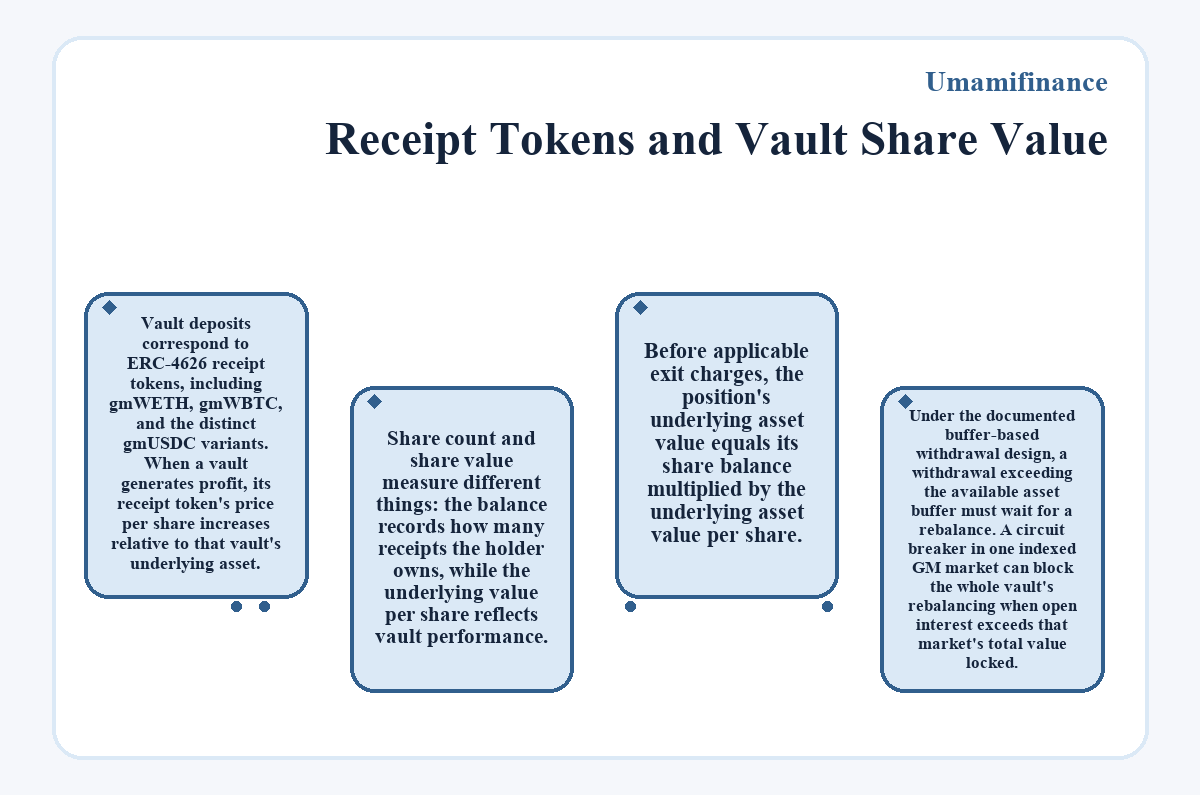
Vault deposits correspond to ERC-4626 receipt tokens, including gmWETH, gmWBTC, and the distinct gmUSDC variants. When a vault generates profit, its receipt token's price per share increases relative to that vault's underlying asset. Share count and share value measure different things: the balance records how many receipts the holder owns, while the underlying value per share reflects vault performance. Before applicable exit charges, the position's underlying asset value equals its share balance multiplied by the underlying asset value per share. Under the documented buffer-based withdrawal design, a withdrawal exceeding the available asset buffer must wait for a rebalance. A circuit breaker in one indexed GM market can block the whole vault's rebalancing when open interest exceeds that market's total value locked.
Price Keepers and Administrative Powers
Keepers submit prices and strategy updates that the contracts validate on-chain. The deposit and withdrawal keeper supplies signed Chainlink prices; the rebalancing keeper submits proposed allocations and hedge settings. These roles don't grant unrestricted authority to remove vault funds.
A 3-of-6 administrative multisig can update strategy parameters, alter vault fees, pause functionality, and upgrade core logic. A separate 1-of-6 pauser can pause functionality but has no other powers. Non-custodial deposits therefore remain exposed to contract configuration and administrative decisions. Guardian audited the GM Vaults, while earlier GLP audits covered code reused in the newer product.
Bonsai Governance and Conditional SEED Rewards
Bonsai DAO owns Umami as a SubDAO, with protocol revenue flowing to the Bonsai treasury.
Legacy UMAMI and Staking Tokens
The former UMAMI governance token migrated to Bonsai, so Umami no longer has a separate governance token. sUMAMI is a legacy staked-UMAMI token. ARBIS was deprecated and merged into UMAMI; its old exchange contract is no longer funded. Umami's April 2, 2024 Bonsai transition proposal called for retiring Marinate, its token revenue-sharing product.
SEED and Bonsai Purchase Rights
Eligible staked GM Vault positions can earn SEED alongside vault yield during the Double-Dip campaign, which ends when the redemption pool's Bonsai supply is depleted. Its allocation design prioritizes GM USDC vaults, with smaller ETH and BTC incentives subject to deposit caps.
SEED rewards provide access to discounted Bonsai purchases through a separate vesting arrangement. They aren't a direct Bonsai payout: the eventual purchase requires ETH and sufficient Bonsai in the redemption pool. The discount varies. Even completed vesting doesn't ensure that a purchase can execute while the pool is empty.
A GM Vault position follows its deposited asset and liquidity strategy. A Bonsai token holding represents exposure to the wider DAO's token economy.
Umamifinance: quick answers
Can I Transfer My GM Vault Receipt Tokens to Another Wallet?
GM Vault receipt tokens are transferable, and the yield belongs to the wallet that holds them. Sending the tokens to an address you don't control transfers the yield-bearing position. The original depositing wallet doesn't keep receiving that position's future yield after transferring its receipts.
What Can Make a GM Vault Balance Lower Just After a Deposit?
A minting charge and trader profit and loss can make the position's displayed value lower than the deposited amount. This difference doesn't, by itself, establish an error. Future vault performance can change the value, and a later recovery shouldn't be treated as certain.
Does Unstaking a Double-Dip Position Stop SEED Rewards?
Unstaking pauses SEED rewards and triggers deboosting under the Double-Dip campaign.
Is Umamifinance Still an Olympus DAO Fork?
Umami moved away from the Olympus-style model used by its predecessor, ZeroTwOhm (Z2O). Z2O launched in October 2021, but none of its original smart-contract code remains in use. The GM Vault model centers on GMX v2 liquidity strategies, rather than the predecessor's bonding and staking system.
Are GM Vault Deposits Reserved for Institutions?
GM Vault deposits are permissionless and available to retail participants, as well as institutions. A supported wallet and the selected deposit asset provide the technical starting point on Arbitrum. Permissionless access doesn't override restrictions that apply in a participant's jurisdiction.
Does Umami Promise Reimbursement After an Exploit?
Umami doesn't guarantee compensation for losses from exploits, hacks, or other unforeseen events. An audit and a non-custodial structure don't create a reimbursement promise. Administrative pause powers also serve a different purpose from insurance or a commitment to repay affected depositors.